How day numbers work
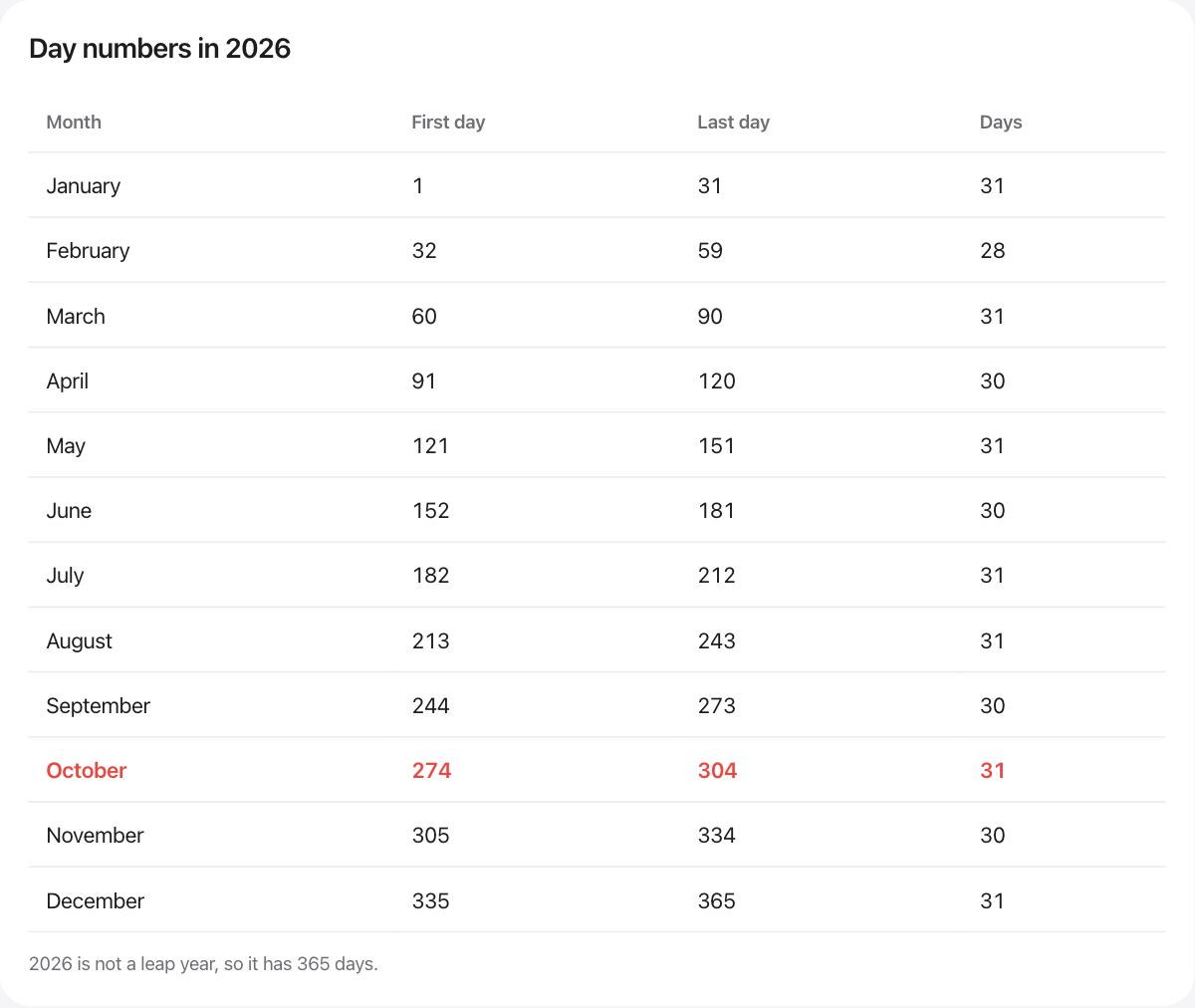
January 1 is day 1, February 1 is day 32 and December 31 is day 365, or day 366 in a leap year. Every date has its own number, and the numbers never repeat within a year.
Day numbers make it easy to count days between two dates in the same year. Subtract the smaller number from the larger one. From day 100 to day 150 is 50 days.
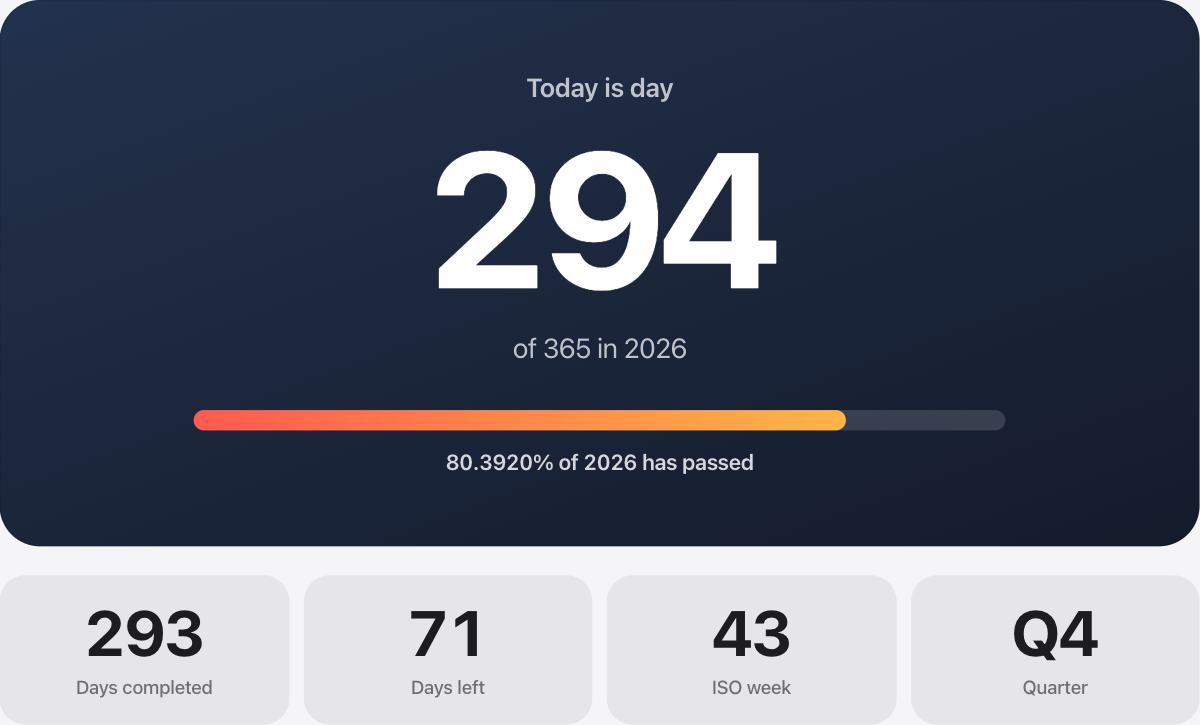
How many days has it been this year?
Counting today, 295 days of 2026 have begun. Counting only the days that are over, it has been one less, which the Days completed tile shows.
Both answers are right. Which one you need depends on whether today should count, for example in a streak or a 100-day challenge.
Where day numbers are used
- Lot codes on food and medicine, where a code like 26295 shows the year and the day something was made.
- Military and government forms, which often call the day number a Julian date.
- Science, farming and weather records, where data is grouped by day of the year.
- Planning, to see how far a project or habit has come through the year.
ISO weeks and quarters
ISO weeks start on Monday, and week 1 is the week with the year’s first Thursday. Most years have 52 weeks, and some have 53. Quarters split the year into four: Q1 is January to March, Q2 April to June, Q3 July to September and Q4 October to December.
Questions and answers
What day of the year is today?
Today, Thursday, October 22, 2026, is day 295 of 365.
How many days has it been this year?
Counting today, 295 days of 2026 have begun. Without today, it has been one day less.
How many days are in 2026?
2026 has 365 days, so its day numbers run from 1 to 365.
Is the day of the year the same as the Julian date?
Many people call the day number a Julian date, usually with the year in front, like 26295. Astronomers use the name for a different count of days. The urTimer Julian date page explains both.
Which week of the year is it?
The ISO week tile above shows it. ISO weeks start on Monday, and week 1 is the week with the year’s first Thursday.