Two meanings of Julian date
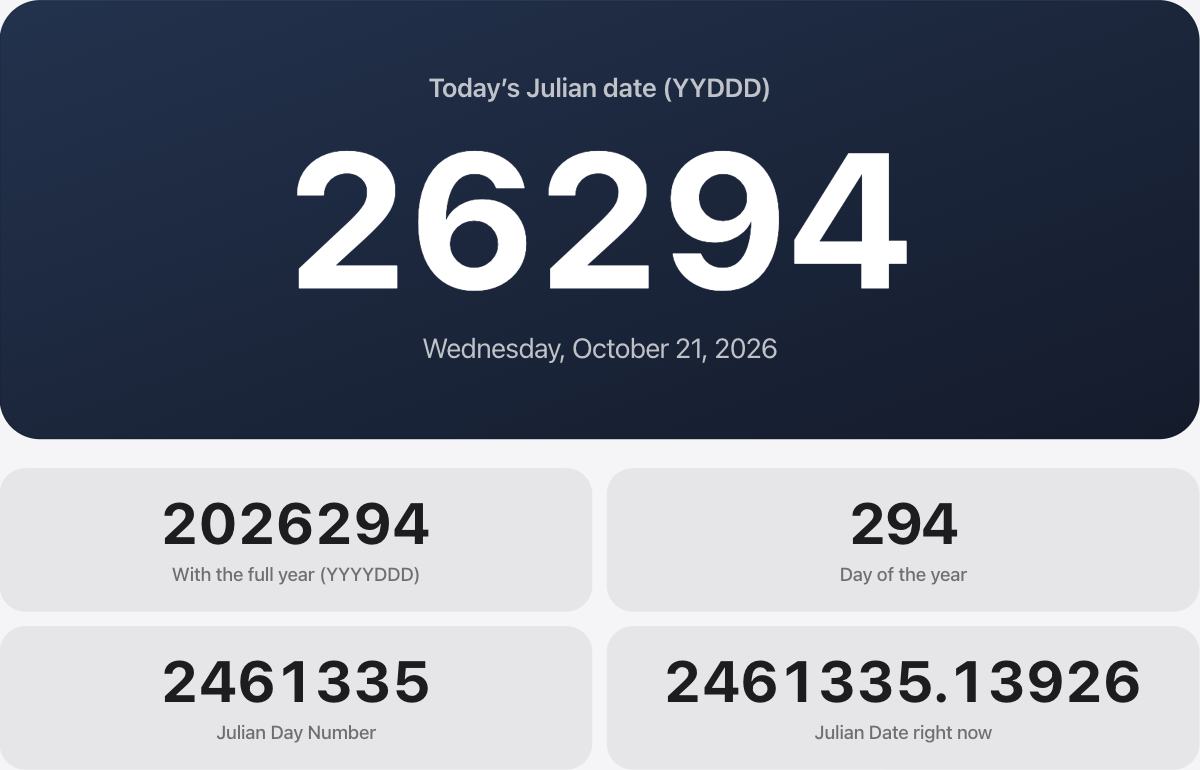
In business, food production and the military, a Julian date is the year followed by the day of the year, written YYDDD. 26295 means day 295 of 2026. Some systems write the full year instead, as YYYYDDD.
In astronomy, the Julian Day Number counts whole days since noon on January 1, 4713 BC. Today’s is 2461336. A Julian Date adds the fraction of the day that has passed since noon UTC, so it keeps ticking forward.
Neither is the Julian calendar, the older calendar from ancient Rome that now runs 13 days behind the calendar we use.
How to read a YYDDD date
- The first two digits are the year, so 26 means 2026.
- The last three digits are the day of the year, from 001 to 365, or 366 in a leap year.
- Day 032 is February 1. Day 060 is March 1 in a common year and February 29 in a leap year.
- Leading zeros matter: 26005 is January 5, 2026, and 26050 is February 19.
Where you’ll see Julian dates
- Lot and batch codes on food, drinks and medicine
- Military and government paperwork
- Manufacturing, shipping and warehouse logs
- Older computer systems and databases
- Astronomy and satellite tracking, which use Julian Day Numbers
Questions and answers
What is today’s Julian date?
In YYDDD format, today’s Julian date is 26295. That is day 295 of 2026.
What is today’s Julian Day Number?
The Julian Day Number for today is 2461336. Astronomers start each day at noon UTC, so the number changes at noon UTC.
How do I convert a Julian date to a calendar date?
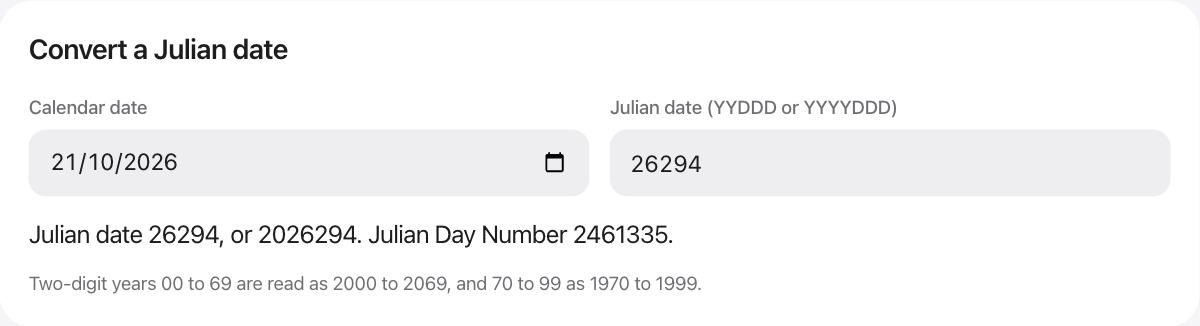
Split it into the year and the day number, then count that many days from January 1. 26032 is the 32nd day of 2026, which is February 1. You can also type it into the converter above.
Is a Julian date the same as the Julian calendar?
No. The Julian calendar is the calendar Julius Caesar introduced, which now runs 13 days behind the Gregorian calendar. Julian dates and Julian Day Numbers are counts of days.
How many days are in 2026?
2026 has 365 days, so its Julian dates run up to day 365.